

Resources
Statistics from Occupational Safety experts indicate that slip-and-fall accidents are one of the leading causes of employee injury in restaurants, bars and other industries.
In Ontario, Bill C-45 which came into force states that:
"Everyone who undertakes, or has the authority, to direct how another person does work or performs a task is under a legal duty to take reasonable steps to prevent bodily harm to that person, or any other person, arising from that work or task."
Visit http://www.ccohs.ca/oshanswers/safety_haz/falls.html for more information on Ontario Occupational health & safety regulations.
- CCOHS states that "Statistics show that the majority (60 percent) of falls happen on the same level resulting from slips and trips. The remaining 40 percent are falls from a height."
- CCOHS further states that in Canada, "some sixty thousand workers get injured annually due to fall accidents. This number represents about fifteen percent of the "time-loss injuries" that were accepted by workers' compensation boards or commissions across Canada. Not mentioning a great economical loss, it amounts for a lot of pain and suffering and sometimes (much too often) even death. All these, in most of cases, do not have to happen." (document confirmed current June 5, 2008)
What is Nano-Grip?
Nano-Grip® is a uniquely formulated chemical compound designed to react with silica sand in the surface. This process creates a positive slip resistant environment without aesthetically changing the appearance of the surface. Because this treatment is not a topical application, it will not crack, peel, chip or discolour with age. There will be no tread patterns or wear patterns on the surface in high traffic areas. These treatments can be applied and reapplied without jeopardizing the structural composition of the surface material. Although not intended to be a cleaning agent, this process will also purge and brighten surfaces renewing its appearance.
Nano-Grip® can be used on almost all hard surfaces (such as ceramic tile, glazed brick, marble, polished stone, terrazzo, river rock, concrete, quarry tile, porcelain and enamel bathtubs & showers) and can be applied to all interior surfaces (lobbies, hallways, washrooms, bathtubs, showers, kitchens, pool areas and change rooms) and exterior surfaces such as walkways, stairs and patios.
Points of Interest
- Nano-Grip® treatments actually make the surface safer to walk on wet than dry.
- Treatments are guaranteed for two years.
- Reduced likelihood of injuries and medical costs.
- Reduced potential for WC claims and control WC premiums.
- Increased protection from law suits.
Our goal is to work with you to attain proper tread patterns and SCOF level that ensures the safety of your environment.
Each Nano-Grip Treatment is applied by one of our certified technicians. Our technicians will conduct an assessment of the surface being treated and determine a customized ratio of treatment and SCOF (Static Co-Efficient of Friction) that will be created for your specific surface material in your specific geographical area. Once the product has been applied and neutralized, there is no need for curing or drying time. These treatments will be completed at a suitable time that will not impede your flow of business. Your daily operations can proceed as normal.
What is a Tread Pattern?
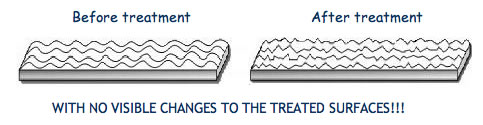
A Tread Pattern is best described as the fingerprint of the surface. All silica sand base surfaces have a smooth fingerprint. Nano-Grip® enters into the pores of the surface and microscopically changes that fingerprint by widening and deepening the pores. The end result?...the creation of a non-slippery tread pattern.
What is a SCOF?
The Static Coefficient of Friction between two solid surfaces is defined as the tangential force required to produce sliding divided by the normal force between the surfaces.
As adopted by Underwriters Laboratory (UL) & American Society of Testing and Materials (A.S.T.M)...
"A static anti-slip coefficient of friction of .50 or above is considered a safe walkway surface with a dry condition. A reading below .50 is considered an unsafe walkway surface."
- .60 or above.....Very Safe
- .50 to .59.....Relative Safe
- .40 to .49.....Dangerous
- .35 to .39.....Very Dangerous
- .00 to .34.....Unusually Dangerous